Storification journal
Brand storyBrand Purpose Isn't a Slogan: How Worldview Turns Customers into Believers
Brand purpose is the belief your business exists to act on. Here's what it is, how it differs from mission and values, real examples, and a simple way to write yours.

Most brand purpose statements could be swapped between companies and nobody would notice. "We exist to empower people to live better lives." Which people? Better how? Who would ever disagree?
That's the problem. A purpose everyone agrees with gives no one a reason to choose you. The brands with real purpose say something some people will push back on, and they act on it.
In Storification I call this your Worldview: the belief about the world that sits underneath everything you do. This article covers what brand purpose is, how it differs from mission and values, the examples worth studying, and a simple way to write yours.
In short: Brand purpose is the belief a business exists to act on: what it wants to change in the world, beyond making money. A strong brand purpose is specific, is something some people would disagree with, and shows up in what the business does, not just what it says.
What is brand purpose?
Brand purpose is the reason a business exists beyond profit: the change it wants to see in the world and the belief that drives it. It answers the question "what do we believe that others don't?"
A purpose isn't a slogan or a cause you attach to a campaign. It's the belief that decides what you make, who you hire, what you refuse to do and how you talk to customers.
Brand purpose vs mission vs values: what's the difference?
These three get blurred all the time. Here's the simplest way I know to separate them:
| The question it answers | Example shape | |
|---|---|---|
| Purpose | Why do we exist? | "We believe [something about the world]." |
| Mission | What are we doing about it? | "So we [what you do, for whom]." |
| Values | How do we behave while we do it? | "We always [behaviour], even when [it costs us]." |
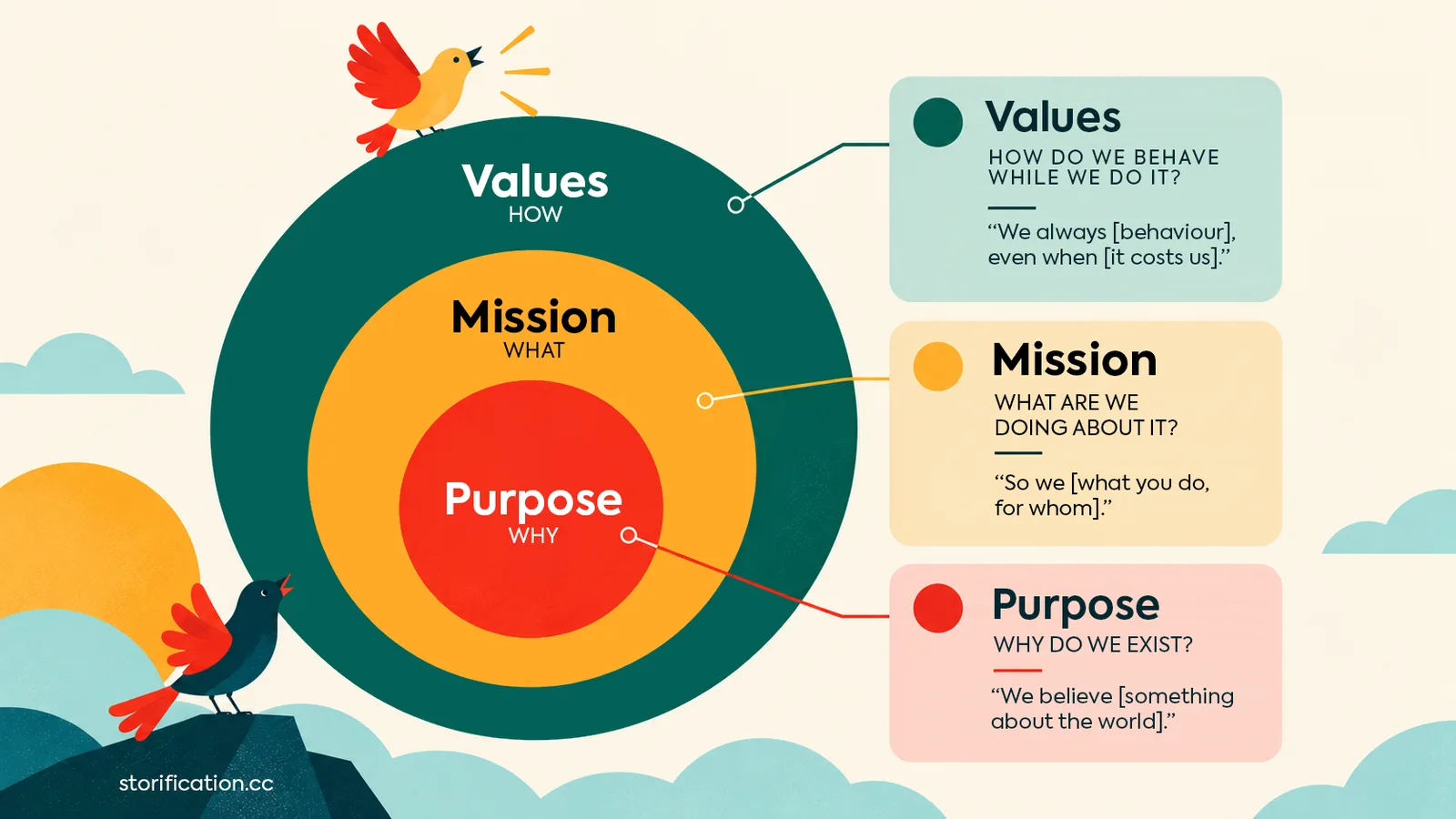
Purpose comes first. A mission without a purpose is a job description. Values without a purpose are a poster on the kitchen wall.
Why does brand purpose matter?
- It gives people a reason to choose you. When products are similar, people choose the brand that shares their view of the world.
- It makes decisions easier. A clear purpose tells your team what to say no to.
- It attracts the right people. Customers, staff and partners who share the belief stay longer.
- It gives your story a direction. Your Origin explains why you started. Your purpose explains where you're going.
People don't buy products as much as they buy alignment with an identity they already carry. A purpose is how they recognise you as their kind of people.
Brand purpose examples
Patagonia: a purpose that costs something
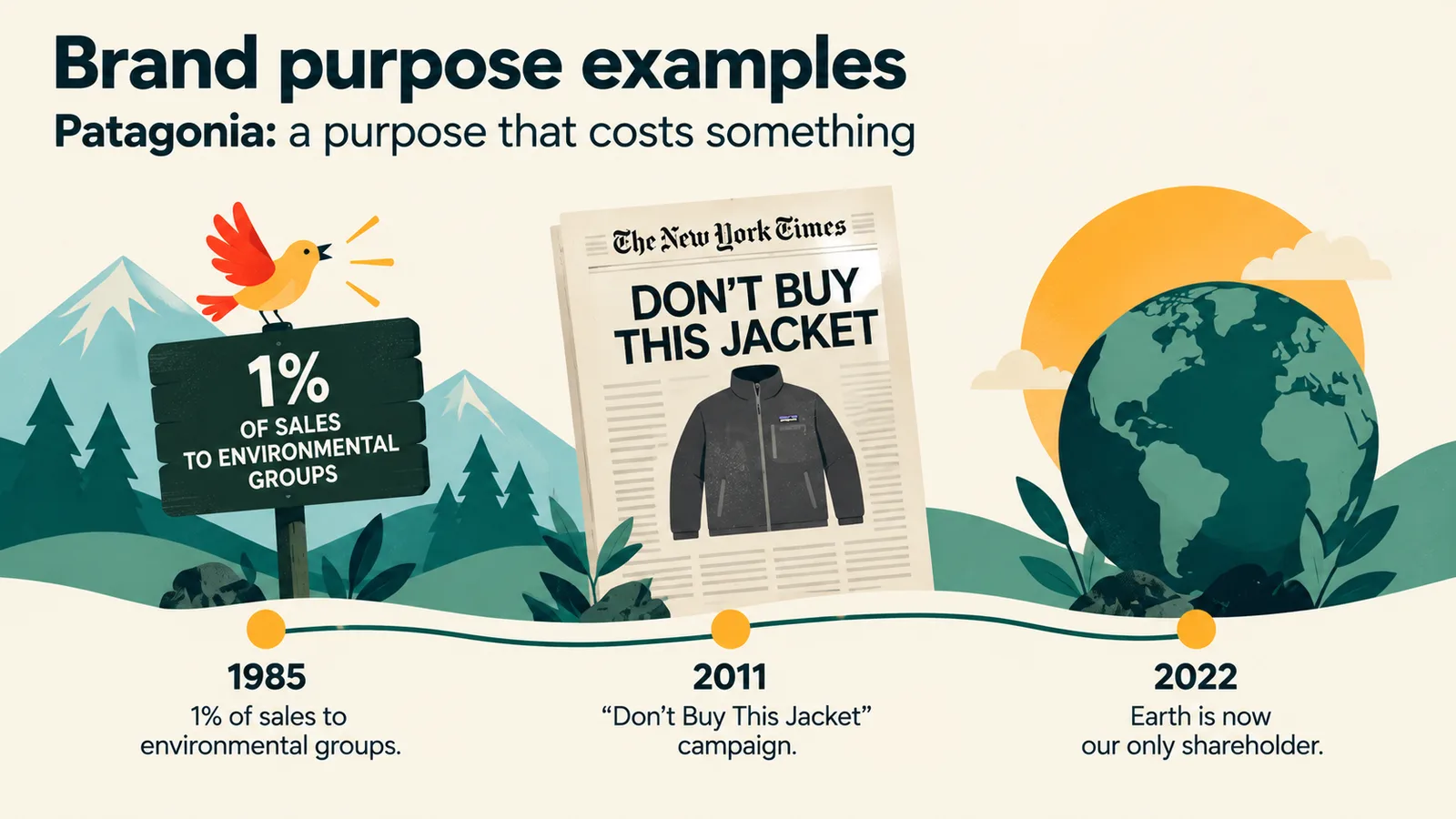
Patagonia's mission statement is blunt: "We're in business to save our home planet." It's been backing that up for decades. Since 1985 the company has given 1% of its sales to environmental groups. On Black Friday 2011 it ran a full-page ad in The New York Times headed "Don't Buy This Jacket". And in 2022 founder Yvon Chouinard transferred ownership of the company to the Patagonia Purpose Trust and the Holdfast Collective, a non-profit set up to fight the environmental crisis, announcing that "Earth is now our only shareholder."
What it gets right: the purpose isn't a line on a website. It costs the company money, and it would be easy to disagree with. That's exactly why people believe it.
Bumble: a purpose built into the product
Bumble launched in December 2014 with one defining rule: on the dating app, women make the first move. For a decade, that single rule carried the brand's whole view of how relationships should start.
What it gets right: for years, you couldn't use the product without living the purpose. The belief and the experience were the same thing. That's also why it made headlines around the world when Bumble relaxed the rule in 2024, so that women no longer had to message first. When the purpose is built into the product, changing the product changes the story.
Xero: a purpose told through customers
When I made customer films for Xero when they were just a scale-up moving into Australia, the films were never about accounting software. They were about small business owners facing a myriad of challenges. The belief underneath was simple: small business owners deserve tools that give them their evenings back.
What it gets right: the purpose was shown through customers' lives, not stated in an ad. Showing beats telling.
The purpose of Xero in those early days was embodied in their guiding star statement "Beautiful Accounting Software" which was embodied in their storytelling around how to make accounting a beautiful experience.
What makes a strong brand purpose?
Test yours against these four questions:
- Would a competitor disagree? If every company in your category could say it, it isn't a purpose yet.
- Is it specific? Name the people and the change. "Empowering people" doesn't count.
- Does it cost you something? A purpose you'd drop the moment it got expensive isn't a purpose.
- Can customers see it? If it only lives in a strategy deck, it doesn't exist for them.
How do you write a brand purpose statement?
Start with one line:
"We believe ______, so we ______."
- Find the frustration. Go back to your Origin. What did you keep noticing that other people seemed to accept?
- Turn it into a belief. Flip the frustration into what you think should be true instead.
- Check it for disagreement. Read it to someone who works for a competitor. If they'd nod along, sharpen it.
- Add the "so we". Connect the belief to what you actually do.
- Find the proof. List one thing you already do that shows you mean it. If you can't find one, that's your first job.
What are the most common brand purpose mistakes?
- Writing something everyone agrees with. "We believe in quality" is not a purpose. Nobody believes in the opposite.
- Borrowing a cause. A purpose bolted on for a campaign gets found out quickly.
- Saying it without doing it. People check. A purpose your behaviour contradicts does more harm than having none.
- Making it about you. "To be the leading provider of…" is an ambition, not a purpose. A purpose is about the world you want to change.
- Keeping it internal. If customers can't see it in your products, stories and choices, it isn't working.
Purpose-driven marketing: how do you use it?
Purpose-driven marketing means letting your belief lead, and your products follow. In practice:
- Lead with the belief on your homepage, before the features.
- Tell customer stories that show the belief changing something real.
- Make an Invitation: a small, clear first step for people who share the belief, such as a free tool, a guide or a community.
- Show the proof, especially the decisions that cost you.
That's the move from Worldview to Invitation, the third step of the Storification framework.
Try this today
Write one sentence starting "We believe…" that a competitor would disagree with. Then write one thing you did in the last month that proves it.
Want a head start? The free Story Engine asks a few questions about your business and drafts your Origin, Worldview and Invitation in about five minutes.
Frequently asked questions
What is brand purpose? Brand purpose is the reason a business exists beyond making money: the belief it acts on and the change it wants to see in the world.
What is the difference between brand purpose and mission? Purpose is why you exist. Mission is what you're doing about it. Purpose is the belief; mission is the plan.
What is a good brand purpose example? Patagonia is the most widely cited. Its mission is "We're in business to save our home planet", and it backs that up with decisions that cost it money, including giving ownership of the company to a trust and a non-profit in 2022.
How do you write a brand purpose statement? Start with "We believe ______, so we ______." Base the belief on the frustration that made you start, check that a competitor would disagree, and find one thing you already do that proves it.
Do small businesses need a brand purpose? Yes, and small businesses often have the clearest ones, because the founder's belief is close to the surface. It doesn't need a budget; it needs one honest sentence and the behaviour to back it up.
What are brand values examples? Values describe how you behave while acting on your purpose. Good values are specific and have a cost, for example "We tell customers when they don't need us, even when it loses us the sale."
Sources
- "Patagonia's next chapter: Earth is now our only shareholder", Patagonia press release, 14 September 2022
- "1% for the Planet", Patagonia
- Patagonia, "Don't Buy This Jacket, Black Friday and the New York Times"
- "Bumble", Wikipedia
- "Dating app Bumble will no longer require women to make the first move", CNN Business, April 2024
Jim Lounsbury is a filmmaker who has made films and brand stories in more than 20 countries. His work has been seen in cinemas and on the world's most viewed networks, including: Apple TV, Prime Video, STAN, National Geographic, and more. He works with organisations and start-ups to find and tell their story. His book, Storification, is out 20 November 2026. Pre-order it here.